
Author
Samyukta Srinivasan
Editor
Ben Faust
Publications Lead
Artjom Gavryshev
Introduction
Artificial intelligence (AI) is reshaping how military power is generated and exercised. Unlike previous defence technologies that enhanced specific platforms or capabilities, AI operates across various systems ranging from surveillance and intelligence analysis to logistics and command decision-making. For Canada, this transformation presents a timely policy challenge. As AI becomes embedded in allied defence architectures, such as through the North American Aerospace Defense Command (NORAD) and North Atlantic Treaty Organization (NATO), Canada must balance the benefits of integration with the risks of long-term dependence on external technological infrastructure. AI is driving a long-term shift toward data-centric military power, in which Canada may gain operational capability through alliance integration but may in turn become increasingly dependent on foreign-controlled data and digital infrastructure. This dynamic raises new challenges for sovereignty (data and traditional), strategic autonomy, and defence policy.
AI as a Structural Shift
AI functions as a general-purpose technology comparable to electricity or computing, with system-wide effects across military organizations. These technologies transform how militaries function over time through data integration, organizational adaptation, and infrastructure development. AI’s impact lies in its ability to reshape decision-making processes and organizational structures, not just weapons systems. Research published in the European Journal of International Security similarly highlights that general-purpose technologies produce long-term transformations that advantage actors capable of integrating them across institutions. AI is not a short-term capability gap to close, but a structural shift that will shape defence ecosystems going forward.
Canada’s AI Integration
Canada is already integrating AI into defence planning, emphasizing interoperability, data readiness, and collaboration with allies and industry. This reflects a broader transition toward a connected battlespace, where military effectiveness depends on real-time data sharing and analytics. Historically, this integration has occurred predominantly within U.S.-led technological ecosystems, most notably through NORAD modernization efforts. However, this dynamic is beginning to shift. Canada's Sovereign AI Compute Strategy commits up to $2 billion toward building domestic AI infrastructure. In January 2026, the federal government launched a call for proposals for sovereign, large-scale AI data centres exceeding 100 megawatts, primarily targeting commercial and research compute needs. The initiative includes data residency in Canada and reliance on Canadian suppliers as explicit evaluation criteria. Whether these civilian-focused investments translate into defence-specific sovereignty remains an open question, but they signal a meaningful pivot toward digital self-sufficiency.
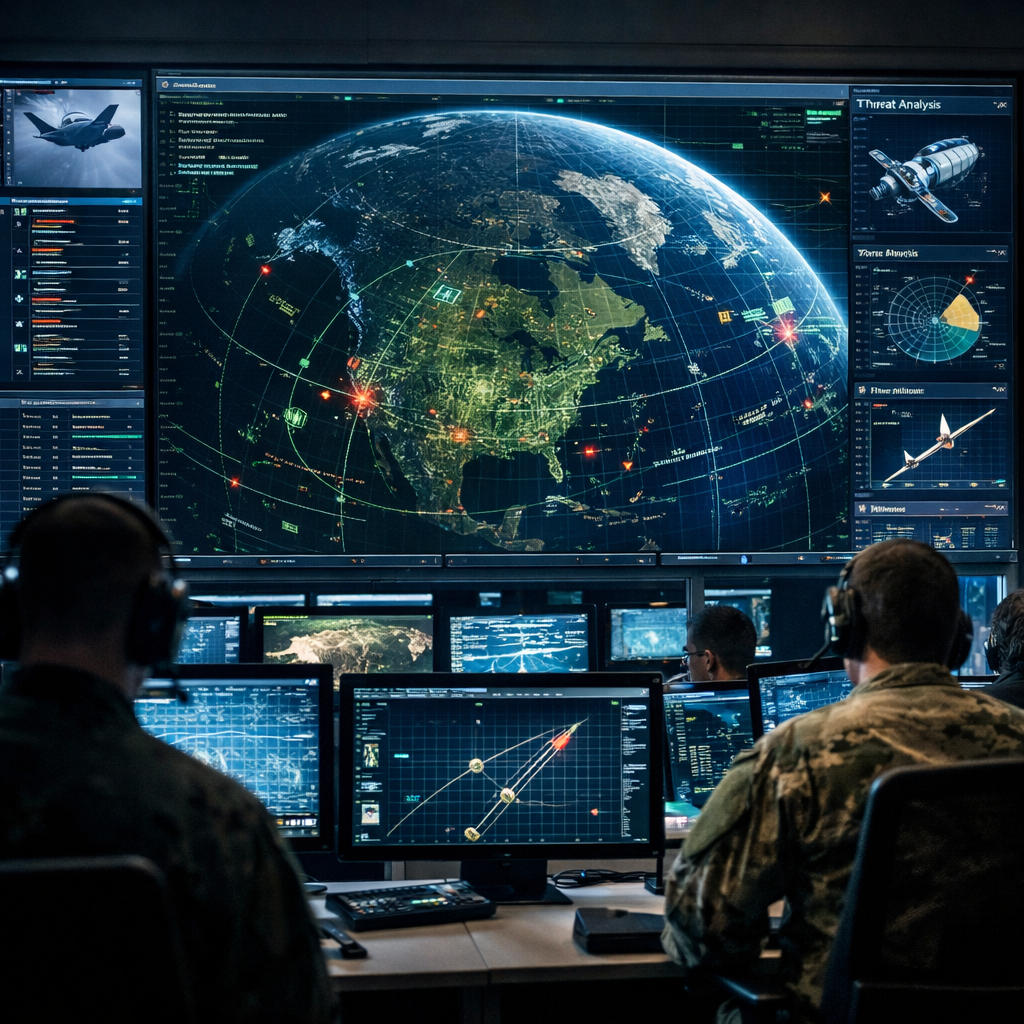
NORAD modernization, including Canada’s $38.6 billion commitment to continental defence upgrades, centres on advanced radar systems, space-based surveillance, and data fusion capabilities designed to detect and track emerging threats. These systems depend heavily on AI-enabled analytics and are largely developed and operated within U.S.-controlled infrastructure. While NORAD is formally a binational command (meaning it operates under a combined Canadian-American command structure with shared authority over North American aerospace defence), the U.S. provides the majority of its technological infrastructure, including early warning systems, data networks, and advanced analytical capabilities, reflecting a broader imbalance in resources and innovation capacity.
Thus, Canada’s role in NORAD modernization is rather complementary and limited. Canada provides critical geographic positioning, particularly in the Arctic, contributes personnel and operations, and invests in domain awareness. Yet, Canada’s reliance on U.S.-led tech systems, particularly for high-end data processing and AI-enabled decision support, creates asymmetries that are reflected in Canada’s limited control and ownership of core technological foundations. This includes a lack of sovereign control over the cloud environments underpinning many U.S. defence systems. Article 19 of the Canada-United States-Mexico Agreement (CUSMA), further limits Canada’s ability to restrict cross-border data flows. The result is a clear trade-off; Canada gains access to advanced AI capabilities, but does so within systems it does not fully control.
Data Sovereignty
At the centre of this transformation is data sovereignty, which is defined as Canada’s right to control access to and disclosure of its digital information subject only to Canadian laws. In defence contexts, this extends to the ability of a state to control the collection, storage, and use of data within its military systems. This creates a structural tension for Canada; participation in allied systems requires data integration, but integration can limit independent control over data and infrastructure. The book Defence Planning for Small and Middle Powers argues that access to advanced technologies increasingly comes through participation in shared ecosystems rather than national ownership. This applies in the Canadian case – defence planning has long been shaped by alliance integration, interoperability requirements, and structural dependence on larger partners, particularly the U.S. Sovereignty in this context is no longer only territorial; it is also infrastructural and digital. Canada faces this challenge most acutely in cloud infrastructure – over 80% of Canadian cloud services rely on foreign infrastructure, creating systemic dependency on providers subject to foreign legal process. For example, the Department of National Defence runs Defence 365 on Microsoft platforms, meaning that even sensitive defence operations may be subject to U.S. legal jurisdiction regardless of where the data physically resides.
Implications for the Balance of Power
AI is shifting the balance of power in three important ways. First, military advantage depends less on individual platforms and more on integrated data and decision systems. Second, alliances are deepening their technological integration, but participation is asymmetric. States such as the U.S. design and control core systems, while partners operate within them. Third, power increasingly resides in data, compute, and infrastructure, which are often transnational and privately owned. The U.S. illustrates this shift through systems such as Joint All-Domain Command and Control (JADC2) and the Joint Warfighting Cloud Capability (JWCC), which integrate data across domains into a unified, AI-enabled network. These systems give the U.S. control over data flows, technical standards, and system architecture, as they are supported by large-scale cloud infrastructure and data architectures operated by U.S.-based firms such as Amazon, Microsoft, Google, and Oracle. This creates a structural asymmetry. States that build and control these systems can shape how AI is deployed and scaled across alliances. Conversely, allies such as Canada rely on integrating into these architectures rather than developing sovereign alternatives. While countries like China are building parallel systems, most middle powers remain dependent on external providers. The result is a hierarchical technological order in which a small number of states control AI-enabled defence systems, while others (such as Canada) operate within them.
Counterargument
Michael C. Horowitz, a leading scholar of military innovation argues that the impact of AI on military power is likely to be gradual rather than revolutionary, as its effects depend on how effectively military organizations adapt to new technologies, a process that is often slow and uneven. From this perspective, technological advantage depends less on access to AI itself and more on how effectively military organizations integrate it into existing structures. Institutional constraints, including organizational inertia, doctrine, and implementation challenges, can slow adoption and limit the extent to which AI alters military capabilities. As a result, AI may enhance existing systems without fundamentally shifting the balance of power. However, even if adoption is gradual, AI’s integration into data infrastructure and alliance systems can still produce long-term structural effects. The key issue is not whether AI transforms warfare overnight, but whether it reshapes the systems through which power is exercised over time.
Policy Recommendations
To address these challenges, Canada should pursue the following policy priorities:
Strengthen data sovereignty frameworks by developing clear policies on data ownership, storage, and access in defence systems. This includes investing in secure domestic data infrastructure where feasible and ensuring that participation in allied systems does not compromise national control over critical data. This can potentially be done through the establishment of legislative requirements for data localization in classified systems and mandatory privacy impact assessments for all cross-border defence data-sharing arrangements.
Build a stronger domestic defence-AI ecosystem by expanding support for Canadian firms and defence innovation programs, increasing public-private collaboration, and reducing reliance on external vendors for core analytical and decision-support systems. While Article 19 of CUSMA limits Canada’s ability to favour domestic providers on national-origin grounds alone, support can be structured through mechanisms such as increased R&D funding and expanded use of the Industrial and Technological Benefits policy to channel defence contracts toward Canadian AI firms.
Play a more active role in shaping alliance governance of AI by advocating within NATO and NORAD for transparent data-sharing standards, meaningful human oversight in AI-enabled decision-making, and risk-reduction mechanisms to prevent miscalculation (i.e., situations wherein automated or AI-assisted decision-making produces military responses that were not deliberately authorized by human commanders).
Conclusion
The integration of AI in military operations has triggered a long-term transformation that is redefining military power around data, infrastructure, and systems integration. For Canada, the central challenge is not simply adopting AI, but managing the dependencies that come with it. As defence capability becomes increasingly tied to systems beyond direct national control, sovereignty is increasingly dependent on access to and governance of the digital infrastructures that underpin military power. Canada’s strategic task is to remain deeply integrated with allies while preserving enough control over data and infrastructure to sustain meaningful strategic autonomy.